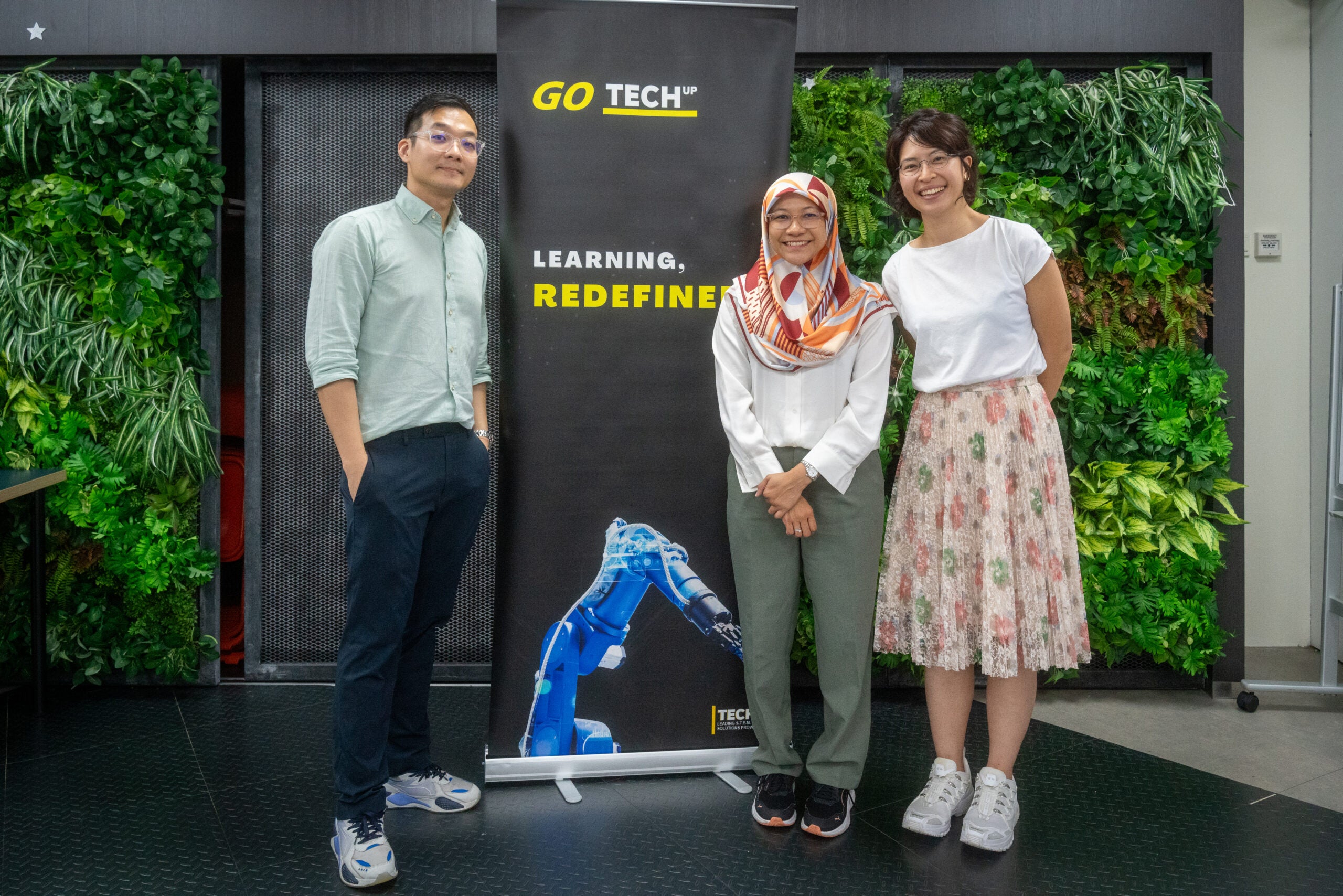

Just as robots are being developed with increasing intelligence and adaptability to help us in our daily lives, Tech Up Advance, a social enterprise start-up is leading the charge in the EdTech landscape with their mission to make robotics education accessible and exciting for everyone.
“In today’s world, robotics is all around us. But in most classrooms, it is not a subject that is taught often,” said Ainaa Rosli, co-founder of Tech Up Advance. “Generally, robotics education is seen as expensive and exclusive. We created GoTechUp, a gamified simulation software to bridge the gap between classroom learning and real-world applications.”
While only 20% of students typically have early exposure and access to robotics education, the remaining 80% often miss opportunities to discover their STEM interests. As a web-based software, GoTechUp democratises access, allowing educators worldwide to engage students in STEM topics through a gamified virtual environment. Students explore 115+ levels of virtual learning while working hands-on with an actual robotic kit.
“Once they saw the robot, they just couldn’t wait to start. Three hours later they wouldn’t let me go home!” exclaimed Sulfya Lim, co-founder of Tech Up Advance, enthusiastically sharing her experience with classroom sessions for the Glyph Community. The start-up trained educators with the children’s charity in Singapore to provide underprivileged children with essential STEM education.
A shared passion for making Robotics fun for all
A love for teaching is evident when hearing Sulfya speak. Her co-founders, Ainaa and Lok Kah Fai, clearly share the same passion. The trio first met as scholarship students, took different career paths, and reconnected when their paths crossed years later.
Pursuing her love for edtech, Ainaa had set up education businesses in the past, roping in Kah Fai who had transitioned from a manufacturing process engineer to running an IoT business. As Technical Advisor for Tech Up Advance, Kah Fai leads the engineering of GoTechUp.
“I love playing games, and I wanted to bring that element of fun into teaching robotics too,” Kah Fai shared. “We used a robotic kit to teach coding to kids in the past, and now with GoTechUp, we are teaching kids through gamified simulations, which is a more intuitive platform and engages them on a deeper level.”
Sulfya joined the duo after leaving a successful career in banking, steering the start-up’s finances and operations as CFO and COO. While on a career break, she rediscovered her joy in learning.
“I started to notice everyday things and became fascinated by the science behind them. I realised I was never exposed to STEM education at an engaging level. When I saw what Ainaa and Kah Fai were doing with GoTechUp, it resonated with me deeply. I tried it out and became hooked.”
Gamified STEM education starts for 5-year-olds
The gamified simulator software has two modules, GoTechUp Junior for kids aged 5-7, and GoTechUp x ArtecRobo, which is suitable for everyone above the age of seven.
In each module, students operate a virtual robot to complete mini quests in each level. The quests are designed to build foundational STEM education, ensure stable progression and seamless transition to a robotics hardware experience. Students can monitor their in-game progress and are prompted to explore creative approaches to problem-solving.
“GoTechUp is developed based on a digital twin concept–what you programme and see in the virtual world, you can actually programme into a physical robot as well. This allows students to ‘jump’ into the world of robots much quicker compared to traditional textbook-based lessons,” Ainaa said.
Balancing profits and social impact
Tech Up Advance is one of the first seven start-ups in the Technology for Sustainable Social Impact (TS2) accelerator programme by NUS Enterprise and the Singapore Centre for Social Enterprise, raiSE. The team had set up base at the BLOCK71 Social Impact Hub, which officially opened in July 2024.
“This year has been a pivotal one for us. The mentorship from experienced entrepreneurs and networking opportunities received through the TS2 accelerator programme are top notch. I think we have found our tribe here in this very supportive community of fellow social entrepreneurs. Everyone understands the unique challenges we face – because we are not just growing a business, we are also trying to change lives here,” Sulfya shares.
Ainaa adds, “When you are prioritising impact, it is difficult for some to understand that things take time because our focus is social development.”
Tech Up Advance has been making great strides. GoTechUp is now used by over 10,000 beneficiaries across Singapore, Malaysia, Japan, Brazil and France today. Selected public schools in Malaysia are using the software, with trained educators having the flexibility to incorporate it into their lesson plans across subjects.
In Singapore, the team has been providing STEM education using GoTechUp to community centres such as Glyph Community and Suncare SG since 2024, reaching out to over 70 community members, including underprivileged children.
The start-up signed an MOU in November 2024 with PT Ruang Teknologi Nusantara (Cube Studio), a creative media centre founded by the Indonesia Endowment Fund for Education (LPDP) Alumni. LPDP has collaborated with NUS Enterprise in developing the I&E ecosystem through scholarships. Through this strategic partnership, Tech Up Advance and Cube Studio will leverage both organisations’ strengths to create transformative learning experiences in STEM education.
To keep the business sustainable, GoTechUp is available to educational institutions through license-based plans. The start-up co-creates with educators who need tailored curricula and want to have their own customised system. This collaborative approach led to QuestUp, a space-themed gamified module whose minimum viable product (MVP) launched recently at Edutech Asia 2024.
Sulfya said, “Impact and profitability can coexist. Our focus is creating genuine value for a better society. Actually, the kids teach us so much. Their joy and sense of accomplishment when learning robotics drive us to go further each day. Ultimately, we want to ignite this timeless curiosity in them to keep exploring what's out there.
We are living our dream. And we want them to live theirs too.”